
Stop. Stay. Share. How to create charity social content for the silent engagers
Comments are down 24% on TikTok and 16% on Instagram. But shares are up.
People are engaging differently.
At our September webinar, social scientist Gina Sipley, Ph.D., author of Just Here for the Comments shared her research on this with us.
The headline is that the majority of people are lurkers on social. Engagement has gone quiet and people are consuming passively.
90% of all participation on social is non-public.
That's the reading, watching, saving and sending to a friend. All of it shapes how people feel about your organisation, and none of it shows up in your comment section.
So how do you create for an audience that mostly stays quiet and engagement metrics don't tell us the whole story anymore?
It's all about the hook. Getting attention in the first place.
You have 1.7 seconds
I know. 🤯
That's roughly how long someone takes to decide whether to stop on your content. And it has to stand out or they're not doing to stay and read the rest of the post, or watch the rest of the video. And if they don't do that they certainly won't share it.
Does your content pass the 'Stop. Stay. Share.' test?
1. Stop - Would this grab attention in 1.7 seconds?
2. Stay - Is the hook strong enough to earn the next 5+ seconds of attention?
3. Share - Would I send this to a friend who cares about the issue?
Here's some inspiration along with ideas for your charity on what passing the Stop. Stay. Share. test could look like.
🐸 Be unexpected
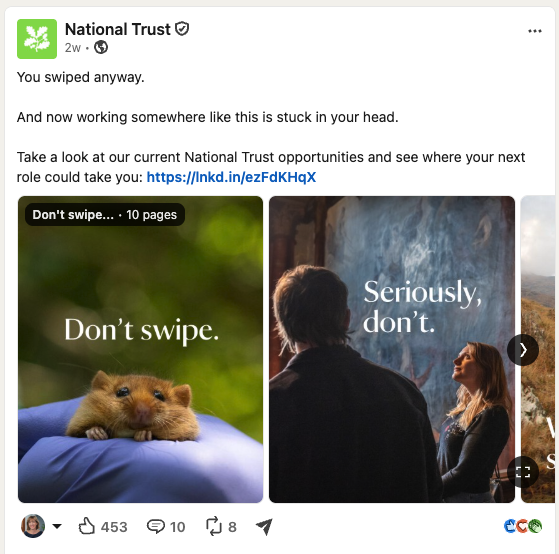
Yes, a National Trust example. Sorry, we reference them a lot - well, they are brilliant on social. And they have animals.
National Trust's recruitment carousel on LinkedIn opens with a dormouse and the words "Don't swipe." Then "Seriously, don't." "Why are you still here?" "Fine. You asked for it."
It's reverse psychology built entirely around making people stay. Cute, clever, unexpected, plenty of engagement.
How could you be unexpected in your charity?
💡Break your own pattern. Surprise is about contrast with what people expect from you. If your feed is usually polished graphics, try a simple phone video from a frontline colleague. If you usually lead with need, share a moment of hope or ordinary everyday life. If you always explain, let one powerful image or line stand on its own. Stay true to your voice but change the angle.
💡Borrow a format from somewhere else. Present your issue in something people read every day. The format does the explaining, and the contrast with your content makes it hit harder. For example:
A weather forecast: "Tonight: -2°C. 300 people sleeping rough in our city."
A property listing: a damp, mouldy flat "available now" at full market rent.
A receipt: an itemised list of what a £10 donation actually paid for.
A school report: honestly graded progress on a policy promise from the government.
🦀 Be bold
One of our favourite accounts, The Crab Museum in Margate regularly pushes the limits of what a museum "should" post. A crab museum talking economics shouldn't work. But it does, because they refuse to stay in their lane and their audience loves them for it. Bold, fun and highly shareable.
How could you be bold in your charity?
Connect your cause to the conversation everyone's already having. Whether it's the cost of living, a heatwave or a news story, ask what the link is to your work, then say it plainly. Bold doesn't have to be loud. A stark stat or one direct sentence can be braver than a meme.
Discuss the problem, not just the need. Instead of "we're here to help," say what's causing the problem and what needs to change. Many charities can speak out on issues linked to their purpose, as long as it's not party political, so stay focused on the issue.
Agree your do's and don'ts before you need them. A short list, signed off by your CEO or chair, of what you'll always speak up on means you can post quickly when the moment comes, without waiting days for approval.
💬 Create space for the unsaid
When Cain's prostate cancer storyline played out in Emmerdale, Macmillan picked up on it the next day (the beginning of a really impactful partnership) with a simple question on a plain background: "Is it OK to ask for support when I'm not the one who has cancer?" They let a moment millions had just watched open a door to a question many people were surely carrying, and the comments filled with people sharing their own experiences. Simple, refreshing, makes people feel understood.
How could you create space for the unsaid in your charity?
Let culture start the conversation for you. When a TV programme, series or news story touches your cause, it gives people permission to talk about something they'd usually keep private. Recognise the moment and respond while it's fresh.
Voice the question, not the answer. Posts that say what people are thinking or feeling can be really powerful. But it's often things they feel they shouldn't ask. Think about the doubts, guilt or embarrassment that come up around your cause, and say it for them. Remember, the majority won't comment - but it will resonate and make an impact.
Be ready for people to open up. If you invite honesty, make sure someone can respond kindly and signpost support. Make sure you're keeping an eye on the post to show care and build trust.
We've spent this whole newsletter thinking about the quiet majority who rarely comment but read, save and send.
So here's our ask 👉 if this was useful, send it to someone on your team who's been staring at a quiet comment section lately. It might cheer them up.
And if you want help building content that passes the Stop. Stay. Share. test, the Social for Good Accelerator is our eight-week programme built by charities, for charities or just shout.
Watch our webinar on this topic: Why Your Social Media Engagement Looks Broken (It Isn't) Sept 2026👇