
Stuck in reactive mode on social? Here's how to get leadership on side
For the comms teams who know what great social looks like, but can't get the space to do it
You're not imagining it.
The feeling that no matter how hard you work, how thoughtfully you plan, how carefully you report — it never quite feels like enough. That you're seen as the person who "does the social media" rather than a strategic voice in the room. That you spend more time justifying your existence than doing the work you know could make a real difference.
We see you. And we're firmly in your corner.
Because here's the truth: this is one of the most common, most demoralising experiences in charity comms. Research shows only 5% of comms professionals feel their role is fully understood by their colleagues. Many describe being treated as order-takers. Always reactive, never strategic. Handed a brief at the last minute and expected to make it work. (The Nonprofit Communications Trends Report, 2026)
It's exhausting. And it's not your fault.
Most of the resistance you face from leadership isn't really about social media. It's about trust, familiarity, and feeling involved. And a lot of it comes from a fundamental misunderstanding of what organic social is actually for — one that's worth addressing head on.
First: let's reset expectations (yours and theirs)
Organic social is not a direct response channel. It will never reliably drive donations, ticket sales or volunteer sign-ups on its own — and if you're being measured against those things, you will always look like you're failing.
What organic social is brilliant at is building the relationships that make everything else possible. It keeps your organisation in people's peripheral vision. It builds trust quietly, over time, post by post. It means that when you do ask for something — a donation, a sign-up, a share — there's already a warm, familiar relationship there to land in.
The audience journey today isn't a neat funnel from awareness to conversion. It's long, non-linear and often invisible.
Someone might see your Instagram post, ignore it, come across you again six months later, visit your website, sign up to your emails, forget about you — and then donate two years after they first encountered you.
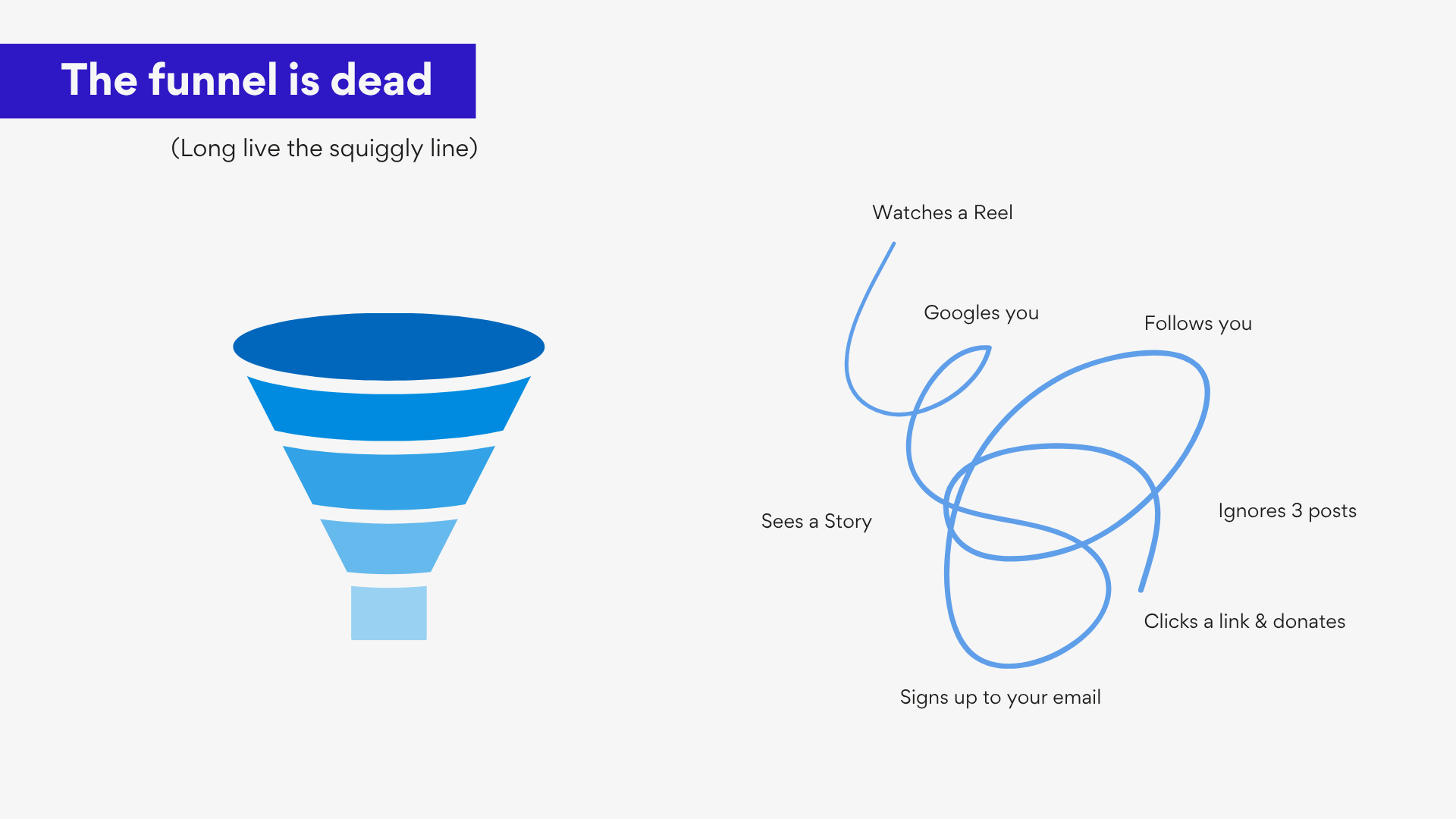
If you measure organic social against the wrong thing, it will always look like it's failing.
Organic social sits all the way through that journey. Measuring it against conversions is like measuring a conversation by whether it immediately resulted in a sale. It misses the point entirely.
This is probably the single most important thing to communicate to your leadership. And once they understand it, the goalposts shift — in a good way.
So how do you actually get them there?
1. Involve them before you need sign-off
The biggest mistake comms teams make is presenting a finished strategy to leadership and hoping for a yes. By that point, you've already lost. They haven't been part of the thinking, so they have no ownership over the outcome.
Instead, ask what success looks like to them before you set your objectives. Start with a simple conversation — what are they hoping social will contribute this year? It gives you something to build your strategy around, rather than having to justify it after the fact.
Share drafts for input, not just approval. People support what they help create. The goal is for leadership to feel like co-owners of your social presence, not occasional critics of it.
2. Move them with stories, not spreadsheets
Most people are moved by stories — not engagement rates. So start capturing the moments that show social is working: a supporter comment that stopped you in your tracks, a DM from someone who found you on Instagram and went on to volunteer, a thread where your community rallied around someone in need.
Keep a running folder of screenshots. Share one in your next leadership meeting, or drop one in a quick email to your boss on a Friday afternoon. It doesn't need to be formal or scheduled.
It's easy to be sceptical about reach figures. It's very hard to be sceptical about a real person saying your organisation changed something for them. One human story can do more for your case than a slide full of metrics — and sharing those moments regularly means social stops feeling like a cost and starts feeling like something worth protecting.
3. Translate, don't just report
When you do share performance data, stop speaking social and start speaking organisational strategy. Connect every metric back to something leadership already cares about.
Instead of "Our engagement rate increased to 4.2%", try: "More of our supporters are actively interacting with us — that's warm audience growth without paid spend."
Instead of "This post had a 32% video completion rate", try: "Nearly a third of people who saw this fundraising story watched it to the end — a strong signal this message is resonating before our autumn appeal."
The numbers are exactly the same. The meaning lands completely differently. And crucially, it demonstrates that you understand what the organisation is trying to achieve — not just what the algorithm is doing.
The bigger picture
Charity comms professionals are doing some of the most meaningful, most undervalued work in the sector. You're building communities, shaping perceptions, and laying the groundwork for relationships that sustain your organisation for years — often with tiny teams, tight budgets, and very little recognition.
You deserve to have that work understood. You deserve a seat at the strategy table. And you deserve leadership that sees social media for what it really is — not a nice-to-have, but a long-term investment in every other goal your organisation has.
We're not going to stop making that case. And neither should you. ✊